Drought-tolerant plants for Austin, sorted by the job you need done
The test for a plant in Central Texas is simple: did it come through the February 2021 freeze, the December 2023 freeze, and the droughts between them, on the assigned watering day, without being babied? The plants below did. They are sorted by what you need them to do.
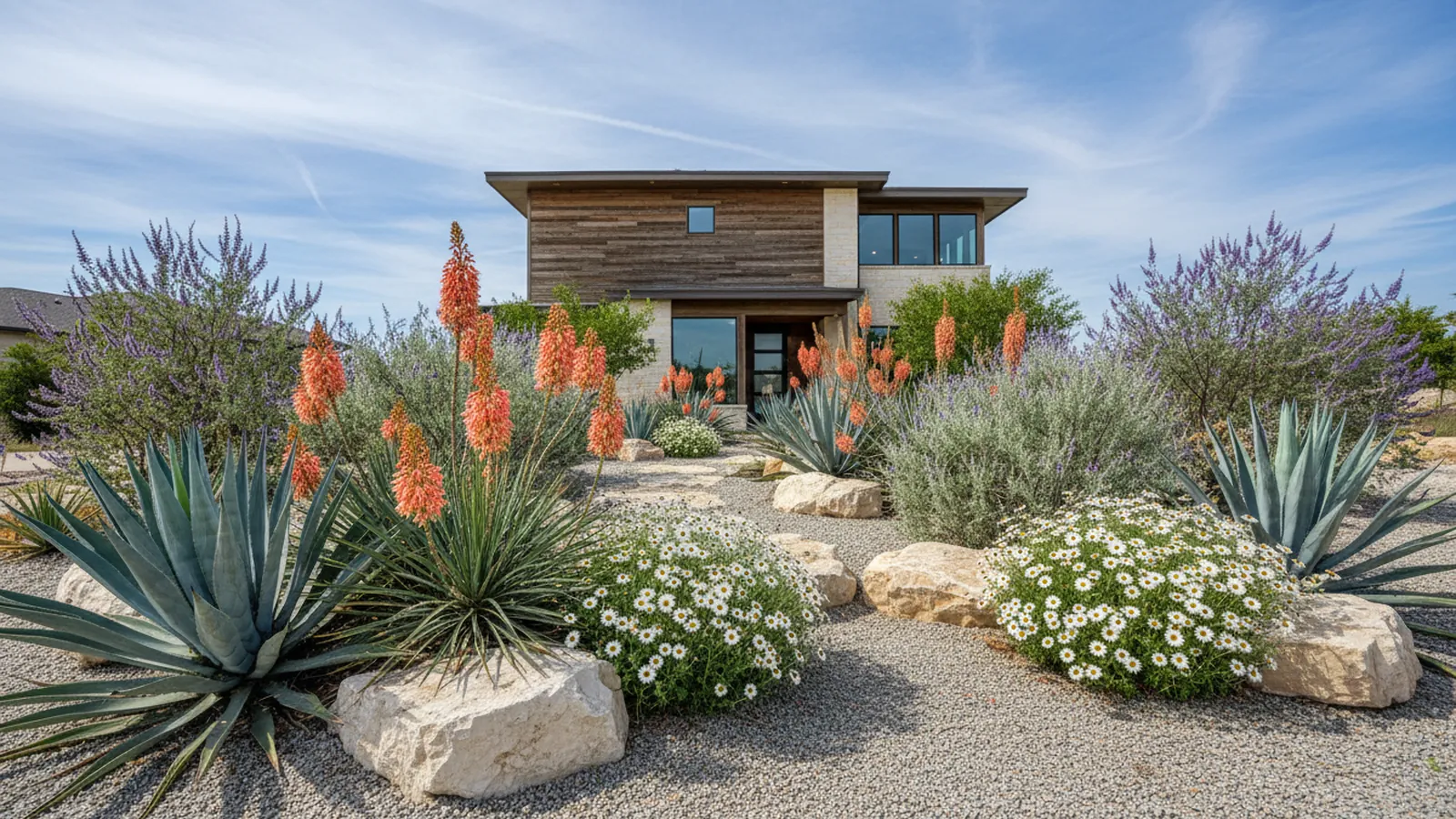
Structure: the plants that hold the design together
Agave (Parry's, Havard's, whale's tongue): sculptural, deer-proof, wants sun and drainage; set it where nobody walks. Yucca (twisted-leaf, soft-leaf, pale-leaf) and sotol: the same virtues with more height. Red yucca: not a yucca, blooms coral all summer, hummingbirds, deer mostly leave it. Texas sage / cenizo: silver leaves, purple flowers after rain, hates wet feet. Agarita: evergreen, holly-like, spiny, deer-proof, red berries for the birds. Dwarf yaupon holly: the hedge that replaces boxwood here. Texas mountain laurel: slow, evergreen, grape-scented purple blooms in March, deer leave it. Possumhaw: deciduous holly, red berries all winter.
Color: the perennials that bloom through heat
Salvias: autumn sage in every color, mealy blue sage, Mexican bush sage in fall; the backbone of an Austin bed. Blackfoot daisy and four-nerve daisy: low, white and yellow, bloom nearly year-round, want drainage. Lantana: the heat-proof workhorse, cut back hard in late winter. Esperanza and pride of Barbados: big, yellow and orange, die back in a freeze and return. Flame acanthus: hummingbird magnet. Plumbago: blue, for part shade. Rock rose and damianita: for the hottest, driest spot in the yard.
Grasses: movement and winter interest
Gulf muhly: pink clouds in October, the most photographed plant in Austin. Lindheimer muhly: taller, silver plumes. Mexican feathergrass: fine and soft, reseeds; keep it out of the beds you want tidy. Little bluestem and sideoats grama: the prairie grasses for a meadow strip. Cut all of them back in late January.
Shade: under the live oaks
Turk's cap: red, blooms all summer in deep shade, hummingbirds. Inland sea oats: a grass for dry shade. Dwarf palmetto: bold, evergreen, slow. Frostweed, cedar sage, Texas betony, columbine (Hinckley's): for the dappled edge. Horseherb and frogfruit: the groundcovers that replace a lawn that will not grow under an oak.
Trees: the ones that will outlive the house
Live oak: the Austin tree, planted in winter, pruned in the window. Mexican white oak (Monterrey oak): fast, oak-wilt resistant, the replacement tree of choice. Cedar elm: tough, yellow in fall. Texas redbud, Mexican plum, desert willow, anacacho orchid tree: small flowering trees for a front yard. Bald cypress for a wet corner. Avoid Arizona ash, Bradford pear and hackberry; they fail young.
By soil and situation
| Situation | Plant these | Skip these |
|---|---|---|
| Limestone, west of MoPac | Agave, yucca, cenizo, agarita, muhly, mountain laurel | Azalea, gardenia, anything wanting acid soil |
| Blackland clay, east of I-35 | Salvias, lantana, Turk's cap, cedar elm, bald cypress | Agave and yucca without a raised, drained bed |
| Deer (Lakeway, Dripping Springs, Leander) | Agarita, cenizo, yucca, salvias, muhly, rosemary, mountain laurel | Roses, daylilies, hostas, pansies |
| Deep oak shade | Turk's cap, inland sea oats, palmetto, horseherb | Bermuda, most flowering shrubs |
| Hottest, driest spot | Damianita, rock rose, blackfoot daisy, sotol | St. Augustine, impatiens, hydrangea |
Questions on this
Are these plants ugly?
No. Gulf muhly in October, mountain laurel in March, salvias all summer and Turk's cap in the shade are the reasons Austin gardens photograph well. A xeriscape done right is a garden, not a gravel lot.
What about the plants that died in 2021?
Pittosporum, oleander, sago palm, bougainvillea, most citrus and many tropicals. Some came back from the roots; most did not. The list above is the one that stood.
When do I plant them?
October through March, so roots are deep before summer. A native planted in July needs daily water for weeks and still struggles.
Do natives need any water?
The first year, yes, regularly, to establish. After that, most live on rain plus a deep drink in a long drought. Drip in the beds covers it inside the watering rules.
Which of these does the HOA accept?
Most, with a submittal; Texas law limits an HOA's power to refuse drought-tolerant landscaping. A tidy design with edging and mulch passes review far more easily than a loose one.
Can I mix these with a lawn?
Yes, and most yards do: a lawn of Bermuda or Zoysia where it is used, and beds of these plants everywhere else, with the irrigation zoned separately.
Related reading: Xeriscaping · Landscape design · Water restrictions · Mulching and beds