Landscape lighting in Austin: a few well-placed fixtures, a live oak lit from below, and nothing that looks like a runway
Good outdoor lighting is mostly restraint. A path lit so you can see your feet, a tree lit so the canopy floats, a step that is never missed, and the rest of the yard left dark enough that the lit parts matter. Low-voltage LED makes it cheap to run; the design makes it worth having.
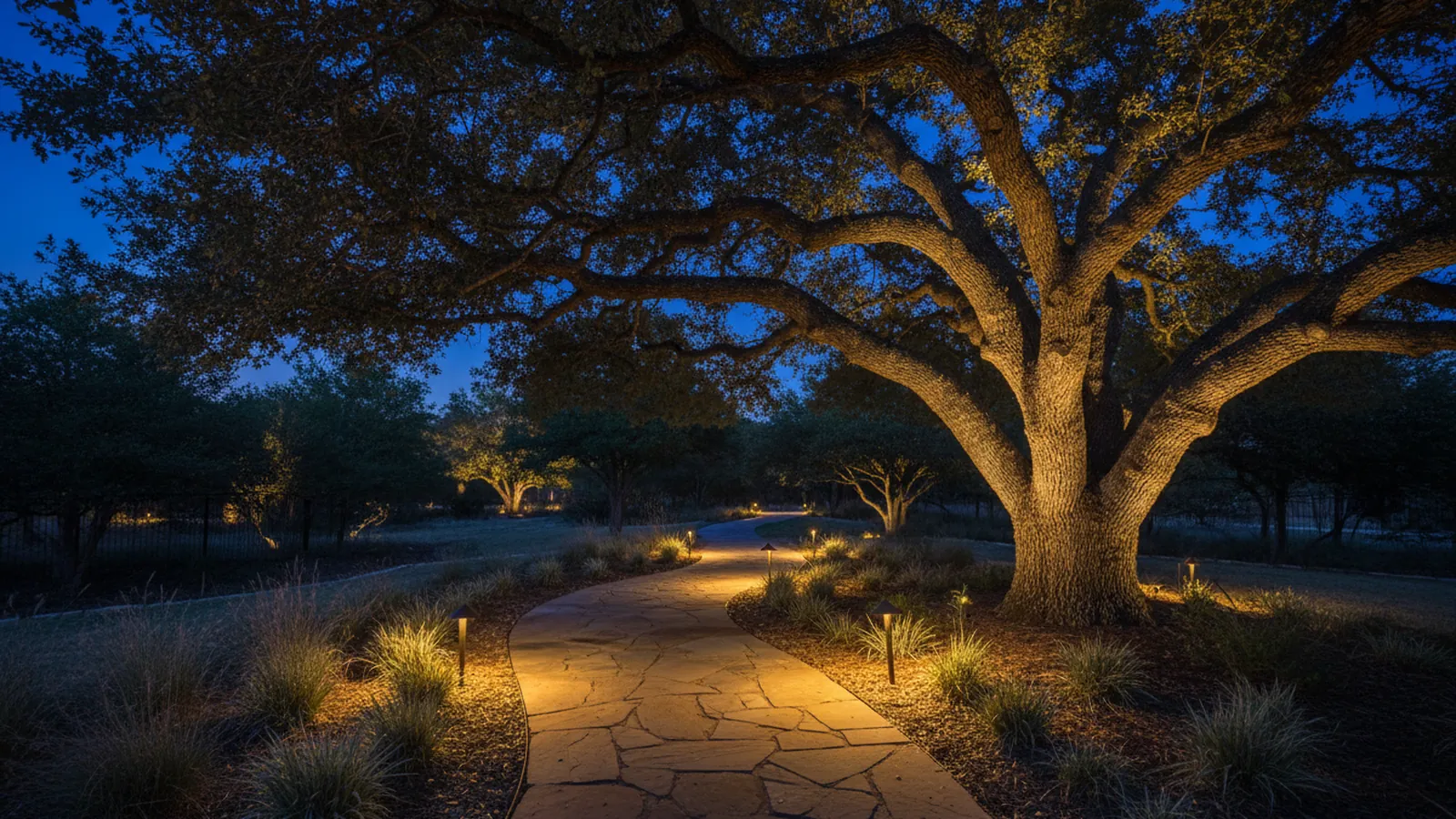
Everything runs at 12 volts from a transformer plugged into an outdoor outlet, which means no electrician, no permit, and a system that can be reworked as the garden grows. The fixtures are LED, drawing a few watts each, so a 300-watt transformer runs thirty lights, and the bulbs last a decade. The job is in the layout and the wiring: a plan walked at dusk, cable runs sized so the far fixtures are as bright as the near ones, waterproof connections rather than the pierce-type clips that fail in a wet Austin spring, and a transformer with a photocell and a timer so the lights come on at dark and off at midnight without anyone thinking about it.
The fixtures fall into four jobs. Path lights, low and shielded, every eight to ten feet along a walk, enough to see the surface and never enough to glare. Uplights on trees, which in Austin means live oaks: one or two fixtures at the base, aimed into the canopy, turn a tree into the centerpiece of the yard after dark. Step and wall lights, set into the riser or the limestone, on any change of level. Wash lights on a stone wall or the front of the house, used sparingly. Fixtures are brass or copper where they will be seen and stepped on, because the aluminum ones pit in the heat and die when the mower finds them.
Austin specifics: the heat is hard on cheap fixtures and the sun is hard on plastic lenses, so the materials matter more here. Oak roots are shallow and protected, so wire is laid in a shallow trench or under mulch, not cut through a root zone. And the lawn crew will meet every fixture eventually, which is why path lights go in the beds, not the turf.
What the crew brings to it
Designed at dusk
The layout walked after dark so the fixtures light what matters and nothing else.
Low voltage, no permit
A 12-volt transformer on an outdoor outlet; LED fixtures drawing a few watts each; a photocell and timer.
Wired to last
Cable runs sized for even brightness, waterproof gel connections, no pierce clips.
Brass and copper fixtures
Materials that take the heat, the sun and the occasional mower; path lights set in beds, not turf.
Oaks lit, roots respected
Uplights at the base of live oaks with the wire laid shallow or under mulch, clear of protected root zones.
Expandable
A transformer sized with headroom so fixtures can be added as the garden grows.
Landscape lighting around Austin: 2026 prices
| Job | Range | Depends on |
|---|---|---|
| Design and layout, walked at dusk | Included | With an installation |
| Transformer, 150–300 W, photocell and timer | $250 – $500 | Capacity, smart control |
| Path light, brass, installed | $120 – $220 each | Fixture grade, run length |
| Tree uplight, installed | $150 – $280 each | Fixture, beam, run |
| Step or wall light, installed | $130 – $250 each | Set into stone or riser |
| Typical front yard, 8–12 fixtures | $2,500 – $4,500 | Fixture count and grade |
| Full property, 20+ fixtures | $5,000 – $9,000+ | Zones, smart control |
| Repair or re-aim of an existing system | $120 – $350 | Connections, fixtures, transformer |
Ranges for Austin and the surrounding Williamson and Hays County towns in 2026, to help you plan. The written estimate after the walk-through is the price; it is itemized, free, and good for 30 days.
On the job
Questions about landscape lighting
Do I need an electrician?
No. The transformer plugs into an existing outdoor outlet and everything downstream is 12 volts. If there is no outdoor outlet where it is needed, an electrician adds one and that is itemized.
How much does it cost to run?
Pennies. Twenty LED fixtures draw about as much as two old incandescent bulbs, and the timer shuts them off at midnight.
Why brass instead of the cheaper fixtures?
Aluminum fixtures pit and corrode in Austin heat and humidity, plastic lenses yellow in the sun, and both die when the mower hits them. Brass and copper last decades and age well.
Can the lights be controlled from a phone?
Yes, with a smart transformer or a plug-in controller, for scheduling and dimming. A photocell and timer does the job for most people without an app.
Will digging hurt my live oak?
Wire is laid in a shallow slit or under mulch, never trenched through a protected root zone. Fixtures at the base of the tree sit on stakes, not in dug holes.
Can you fix a system that someone else installed?
Yes. The usual faults are failed pierce connectors, an undersized transformer and fixtures full of water; most are repairs rather than replacements.